U.S. charitable bequests surged 19.7% in 2025 to $62.19 billion, representing the strongest growth of any donation source. And considering that Generation X is projected to inherit $1.4 trillion on average annually over the next decade, now is the time for nonprofits to invest in effective planned giving software.
Even with this historic wealth transfer, many development teams are struggling, because outdated technology severely limits their fundraising potential. Traditional tools were built just to track deferred commitments or compute complex trust payouts after the gift was negotiated. But waiting for donors to navigate expensive legal hurdles on their own severely limits your campaign reach. Modern planned giving software eliminates a ton of these roadblocks.
Your software shouldn’t just record bequests. It should remove the legal and financial barriers to creating one. To help your nonprofit select the right tools, we’ll explore the following:
- What to look for in legacy giving software
- 7 best planned giving software & tools
- Frequently asked questions about planned giving tools
As you explore this list, remember that the best planned giving tools empower fundraisers to capture legacy gifts while providing donors with free, accessible estate planning solutions. For example, FreeWill provides the backend and donor-facing tools that nonprofits need to secure these transformational gifts. By turning complex tax regulations into transformative revenue, your organization can empower supporters to protect the people and causes they love without getting overwhelmed.

What to look for in legacy giving software
Modern planned giving software must actively remove the legal and financial barriers preventing donors from creating a bequest. Traditional legacy tools were built for finance teams to track complex gifts post-commitment. Today’s most effective platforms prioritize the donor experience directly.
When evaluating platforms, look for these important capabilities:
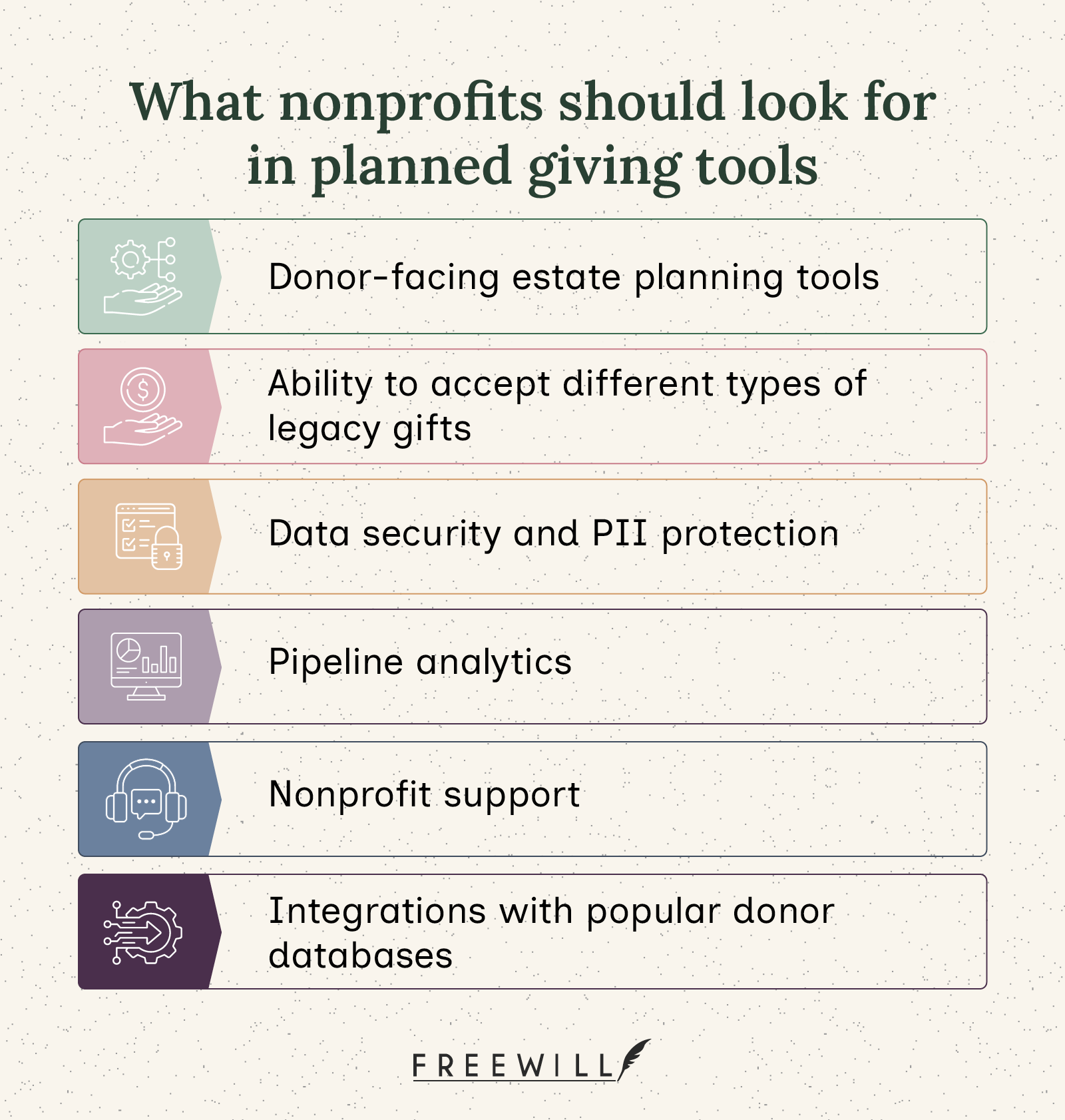
- Donor-facing estate planning tools: Look for systems that offer direct estate planning document creation for your donors rather than just backend administration.
- Ability to accept a range of legacy gifts: Ensure the software can easily accept a variety of legacy gift types, such as bequests, trusts, beneficiary designations (for unused retirement assets and life insurance policies), and gift intent forms
- Data security and PII protection: Protect sensitive donor information and personally identifiable information (PII) with platforms that adhere to rigorous security standards, encryption, and compliance protocols to safely handle confidential donor records and gift intention details.
- Pipeline analytics: Go beyond basic tracking with visual dashboards and reporting tools that forecast future revenue, monitor donor engagement, and help you measure the overall health and progression of your legacy giving pipeline.
- Nonprofit support: Look for vendors that offer dedicated strategic guidance, marketing resources, and ongoing support to help your team effectively launch and scale your planned giving program.
- Integrations with popular donor databases: Your chosen tool must sync automatically with your existing donor database or CRM to prevent manual data entry and disjointed records.
Beyond the software features, ensure your chosen platform aligns with your demographics. Audit your current donor base to determine their most common legacy giving behaviors and match your technology to their habits—whether that means facilitating beneficiary designations for older supporters managing retirement accounts, or offering digital-first will creation tools for younger demographics establishing their estate plans for the first time.
7 best planned giving software & tools
The legacy giving technology landscape features a mix of donor-facing acquisition platforms and backend administrative trackers. The right choice depends on whether you need to generate net-new bequests or manage highly complex existing financial assets. Overall, FreeWill stands out as the best choice for nonprofits who want to educate their donors, simplify the process for them, and secure more transformational gifts.
1. FreeWill
FreeWill's Planned Giving Suite empowers nonprofits to scale their legacy giving programs by providing intuitive tools and expert strategy. Recognized as the #1 online estate planning tool in the U.S. and named CNBC’s best free will-making tool in 2025, FreeWill boasts a BBB A+ rating, a 4.9 on Trustpilot, and features in the NYT, WSJ, Forbes, and AARP. Its platform is legally vetted in-house and by FreeWill Fellows, a network of over 40 trust and estate attorneys across the country.
By removing the traditional barriers and costs associated with will-making, FreeWill makes it simple for donors to leave a charitable bequest while mapping out their full legacy. Compared to the national average, gifts made through estate plans on FreeWill are 4.85x larger. To date, the platform has helped more than 2,400 nonprofits raise over $14.2 billion in legacy commitments, with over 244,000 valid estate plans completed from June 2024 through May 2025 alone (2025 Planned Giving Report).
Planned giving platform features
The Planned Giving Suite offers a comprehensive set of features designed to capture donor intent and drive legacy revenue:
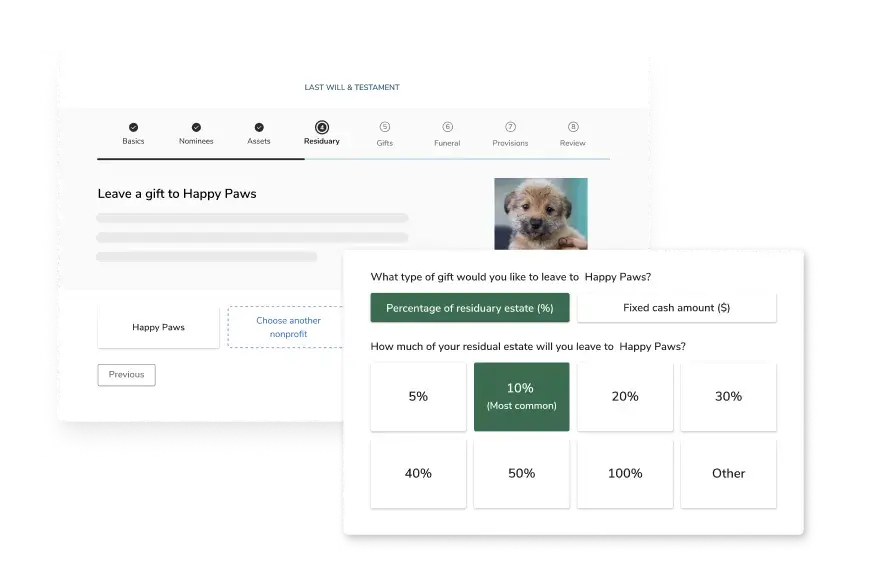
- Donor-facing tools: FreeWill provides online tools that allow individuals in all 50 states and D.C. to easily create legally valid estate plans, including Last Wills and Testaments, Revocable Living Trusts, Advance Healthcare Directives, and Beneficiary Designations. These tools are co-branded with your nonprofit's logo, colors, and messaging to nudge supporters toward charitable giving as they outline their legacy.
- Advanced legal & faith capabilities: The platform also offers advanced capabilities like Special Needs Trusts and faith-informed customizations, allowing faith-based partners to tailor the experience with funeral wishes guidance, guardianship prompts regarding spiritual upbringing, and a personal statement of faith.
- Partner portal: The portal equips teams with real-time donor and gift data, campaign analytics, trend dashboards, DonorSearch integration, and automated stewardship support.
- Planned giving microsites: Nonprofits can launch branded digital hubs that integrate with all of FreeWill's tools, including our Smart Giving Suite for non-cash gifts of stock, crypto, and more. This creates a low-pressure educational environment for supporters to explore their legacy giving options.
- Featureships: Acquire new donors and build brand awareness by placing your mission in front of thousands of will-makers natively on FreeWill's public site, letting the platform make the ask for you.
- Strategy and services: Nonprofits are paired with a dedicated FreeWill Strategist who provides custom marketing content, proven outreach strategies, and exclusive training. FreeWill offers quarterly seasonal campaigns, custom content written in your nonprofit’s voice, "William" (an AI content companion), a marketing library of ready-to-customize Canva templates, and CFRE-accredited Planned Giving and Smart Giving certificate programs.
Hear from a real nonprofit using FreeWill
From donor education to simpler legacy gift program management, hear why NOCO Humane recommends FreeWill:
2. LifeLegacy
LifeLegacy stands out as a turnkey planned giving software solution built for rapid deployment. This platform helps capacity-constrained nonprofits launch legacy programs quickly by providing streamlined solutions for life insurance gifts and digital wills. Its dashboard enables fundraisers to monitor incoming legacy pledges without getting bogged down in complex administration. The platform has helped nonprofits secure more than $200 million in legacy gift commitments.
Planned giving software features
- Turnkey launch: Rapid setup designed for organizations launching their first legacy program using planned giving tools
- Basic digital wills: Simple online document creation that guides donors through charitable bequests
- Pledge dashboard: A clean interface for monitoring incoming legacy commitments
- CRM integrations: Connections with leading tools like Bloomerang and Salesforce to sync planned giving data
3. Crescendo Interactive
Crescendo Interactive provides specialized planned and major gift software for nonprofits and gift-planning professionals. Its cloud-based proposal software combines gift calculations, tax and present-value modeling, technical explanations, and personalized donor illustrations for complex charitable arrangements, including charitable remainder trusts, charitable gift annuities, unitrusts, and other planned gifts.
Its Crescendo Admin product supports the ongoing administration of charitable gift annuities, including payment processing, annuity tracking, tax reporting, reserve calculations, and state reporting.
Planned giving software features
- Tax calculators: Precise mathematical modeling for complex trusts, annuities, and tax-smart gifts
- Proposal generation: Detailed, technical financial illustrations tailored for high-net-worth donors
- Advisor portals: Specialized planned giving tools built for attorneys, financial planners, and other professional advisors
- Backend compliance: Comprehensive administrative capabilities for finance departments managing active financial instruments
4. GivingDocs
Giving Docs is a planned giving software platform for nonprofits that incorporates behavioral science into the donor experience. The platform provides supporters with branded tools for creating wills and other estate planning documents, while helping nonprofits document planned gift intentions, track disclosed gifts, and engage donors in legacy giving. Giving Docs says its approach is informed by behavioral research conducted in partnership with Duke University's Center for Advanced Hindsight.
Planned giving software features
- Behavioral science-backed design: Guide donors through estate planning and the process of sharing their charitable intentions with simple digital tools
- Planned-gift disclosure tracking: Enables nonprofits to track disclosed gifts and use that information to support donor stewardship and planned giving efforts
- Engagement insights: Provides organizations with tools to measure engagement and report the impact of their legacy giving programs
- Branded experience: Incorporates the nonprofit's logo, colors, and messaging into the donor-facing estate planning tools
5. PG Calc
PG Calc is a long-established planned giving software and services provider with a focus on gift calculation, planned gift administration, and compliance-related reporting. Its GiftWrap administration software is designed to manage the specialized data and calculations associated with planned gifts, including charitable gift annuities, while PG Calc's administration services support payments, tax form generation, FASB liability reporting, and state reserve reporting.
Planned giving software features
- Gift annuity calculations: Supports calculations for immediate, deferred, flexible, and commuted charitable gift annuities, as well as other planned gift arrangements
- State and compliance reporting: Provides state reserve reports, FASB liability reports, and consulting support for charitable gift annuity registration requirements
- Administration tracking: Maintains detailed planned gift data, tracks gift values over time, supports beneficiary payments, and manages other ongoing administrative requirements
- Tax reporting: Supports 1099-R generation and electronic IRS filing, along with other tax and administrative reporting associated with planned gifts
6. Trust & Will
Trust & Will is an online estate planning platform designed primarily for individual consumers, with additional solutions for nonprofit organizations. It helps nonprofits make planned giving more accessible to their supporters. Through its nonprofit partnerships, organizations can offer donors a simple digital experience for creating wills and revocable living trusts while making it easy to include a charitable bequest. This creates a lower-friction path for donors, while giving nonprofits opportunities to identify and steward donors who choose to include them in their estate plans.
Be aware that the use of Trust & Will’s tools is not free for the donor unless the nonprofit is on the "enterprise" plan.
Planned giving software features
- Easy donor experience: A consumer-friendly estate-planning interface to reduce the complexity and friction traditionally associated with creating a will or trust
- Charitable bequests: The ability for donors to name a nonprofit as a beneficiary and specify a dollar amount or percentage of their estate
- Planned gift discovery: Ability for nonprofits to encourage supporters to consider legacy gifts and, when donors opt in, receive information about their charitable intentions
- Donor insights and tracking: Visibility into legacy activity, donor intent, and planned-gift commitments through the nonprofit platform, with enhanced reporting and real-time updates available on higher-tier plans
7. PlannedGiving.com
PlannedGiving.com provides turnkey planned giving websites, donor education tools, marketing resources, and online estate planning technology for nonprofits. Its Legacy Center and related products help organizations establish or expand a planned giving program without building the website, educational content, and marketing infrastructure from scratch. The platform combines donor-friendly explanations of planned gifts with branded websites, marketing materials, and tools such as LegacyPlanner to help supporters explore estate planning and charitable bequests.
Planned giving software and marketing features
- Turnkey planned giving websites: Branded digital hubs with educational content covering bequests, beneficiary designations, charitable trusts, gift annuities, and other planned gifts
- Marketing resource library: Postcards, brochures, educational content, campaign resources, and other donor facing materials
- Donor engagement tools: Online resources that encourage donors to explore giving options, request information, and connect with the nonprofit
- Program infrastructure: Legacy Center resources covering website implementation, donor education, marketing materials, and planned giving program development
Pro Tip: Before finalizing your software decision, pilot the donor-facing tools internally. Have your board members or development staff attempt to make a mock gift using the platform. If your own team finds the interface confusing or the steps too numerous, your donors will inevitably abandon the process.
Frequently asked questions about planned giving tools
What is planned giving software?
Planned giving software is specialized technology used by nonprofits to secure, track, and manage deferred legacy gifts. This includes estate commitments like leaving a bequest in a will, naming a charity as a beneficiary, or setting up a trust. The best planned giving platforms help fundraisers track these commitments while giving donors the tools to easily plan their legacy. Traditional systems focus mostly on backend administration, whereas modern platforms help organizations market their programs and acquire new donors.
How is legacy giving software different from a standard fundraising software?
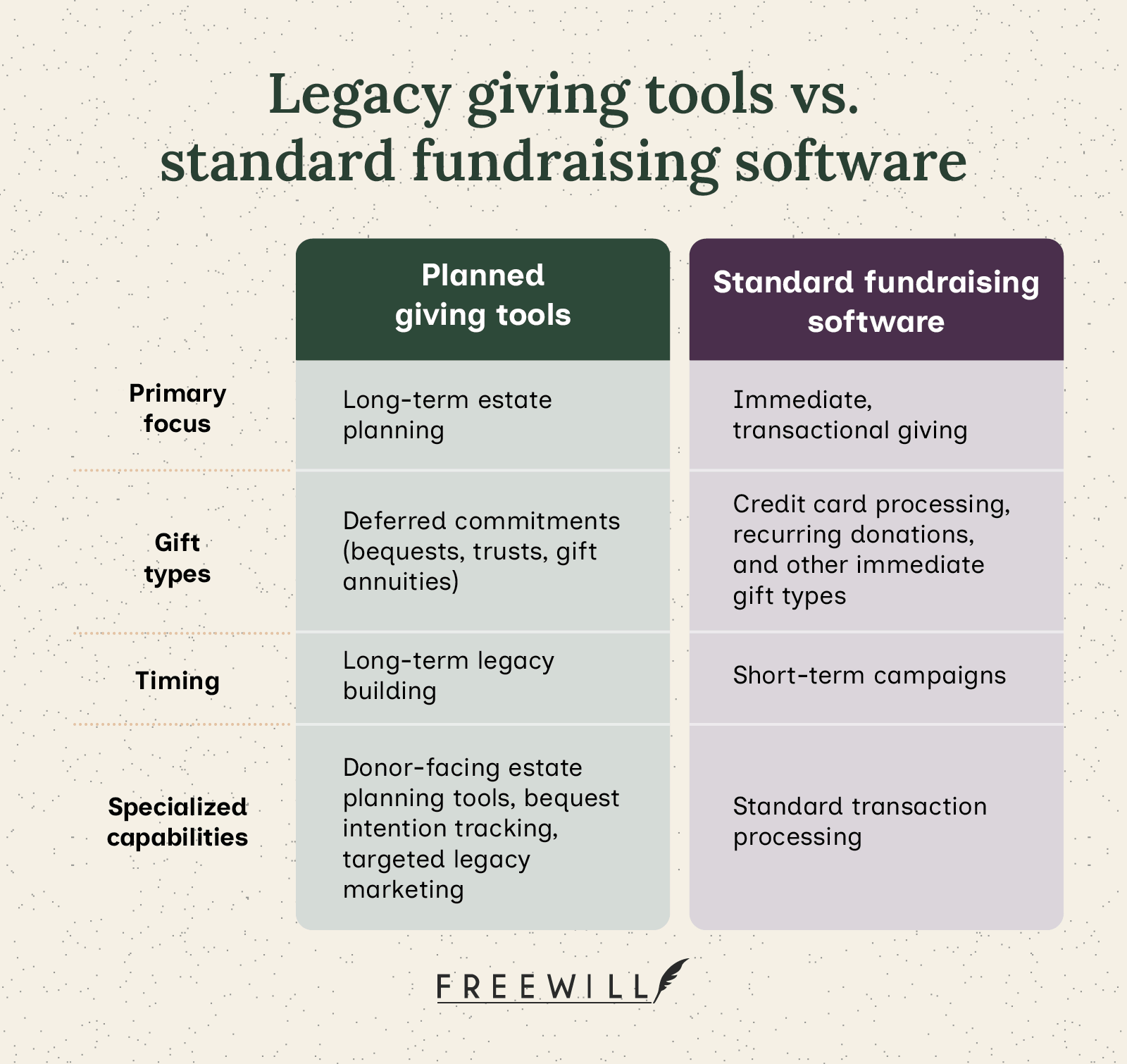
Standard fundraising software handles immediate, transactional gifts like credit card donations and recurring donations for short-term campaigns. In contrast, legacy giving software focuses on long-term estate planning by capturing deferred commitments such as bequests, trusts, and gift annuities. It provides specialized capabilities that standard platforms lack, including donor-facing estate planning tools, bequest intention tracking, and targeted legacy marketing support.
Why is donor-facing estate planning software important for nonprofits?
A major barrier to planned giving is the cost and complexity of creating a will. By offering donors access to a free, intuitive online estate planning platform like FreeWill, nonprofits remove friction and increase the likelihood of receiving bequests. Donors want to support your mission. You must eliminate the expensive legal hurdles standing in their way.
Can planned giving tools handle stock and crypto donations, or do I need a separate platform for that?
Some modern planned giving platforms like FreeWill include tools to accept non-cash assets, such as appreciated stock, cryptocurrency, Donor-Advised Fund (DAF) grants, and Qualified Charitable Distributions (QCDs). While stock and crypto are technically immediate major gifts rather than deferred legacy gifts, software vendors often bundle them into the same platform because both appeal to tax-conscious donors who are evaluating their overall financial strategy.
Final Thoughts
Choosing the right planned giving software depends on your primary goals—whether that means capturing bequest volume, managing tax compliance, or driving donor education. Donor-facing platforms excel at capturing legacy commitments, while administrative tools handle long-term compliance for complex gifts. Take your time picking a platform that fits your capacity, so your nonprofit can secure sustainable, long-term funding for your mission.
Continue learning about legacy giving with these free resources:
- How to start a planned giving program: Step-by-step guide
- Free endowment calculator to project long-term impact
- Modernize Your Planned Giving Brochures to Grow Legacy Gifts