Artificial intelligence is changing the game by streamlining work and improving outputs in all kinds of industries—nonprofits are no exception. In fact, an AI adoption study found that 92% of nonprofits are using AI in some capacity.
One of the highest-impact areas for this technology is AI grant writing. Traditional grant seeking is notoriously time-consuming. Researching, budgeting, and drafting can stretch already-thin resources to the breaking point. Sound familiar?
Today’s tools can ease that burden, helping your nonprofit efficiently apply for and win more funding. But how exactly does it work? Is it safe? And what tools are available?
We’ll answer these questions and more—but first, the most pressing question:
Can you use AI for grant writing?
Yes. Nonprofits can use AI tools to significantly accelerate their grant writing efforts, provided they use a collaborative, human-in-the-loop approach.
AI should not fully replace human writers. Creating a winning proposal requires a deeply human touch to weave together data, emotional storytelling, and highly tailored arguments. To use AI effectively, you must:
- Provide strong context. Feed the AI detailed inputs about your specific goals and organization.
- Review and refine results. Closely edit the outputs to ensure accuracy and alignment with your nonprofit's voice.
The ROI of AI grant writing
Even though a human touch is needed, the amount of work required for you to effectively use AI for writing grant proposals can still be much less than what you’d need to commit otherwise. Master AI grant writing, and you can dramatically speed up your grant workflows while reducing overhead.
For example, Grant Assistant users report completing proposals in one-third the usual time, with tasks normally taking 10+ hours of work reduced to minutes. Pets for Patriots even reported an incredible 80–90% reduction in time needed to complete a proposal. The right tools give your team the power to pursue more funding opportunities than ever before.
What kinds of AI grant writing tools are available?
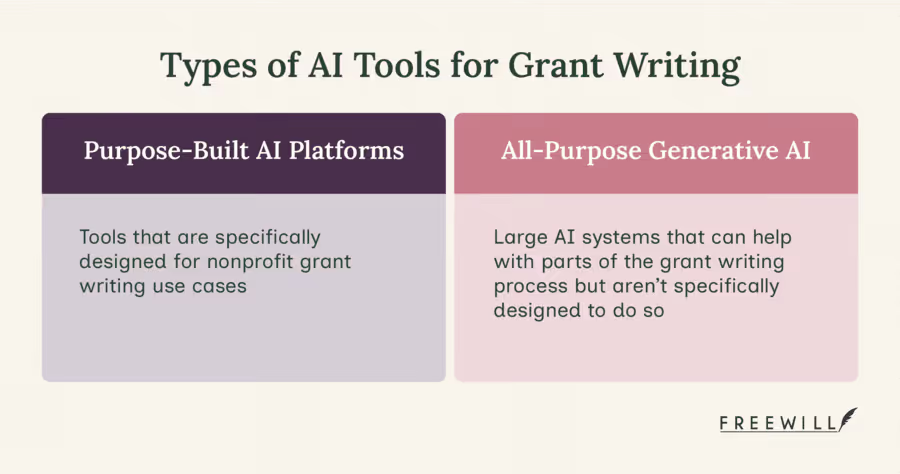
Nonprofits generally rely on two distinct categories of AI tools for grant writing: purpose-built platforms and all-purpose generative AI. Choosing the right tool depends on your organization’s budget, workload, and the level of factual accuracy required.
1. Purpose-built AI grant writing platforms
These platforms are explicitly trained on successful grant proposals, funder data, and nonprofit compliance standards.
- Examples: Grant Assistant
- Key features: Automated funder matching, compliance checking, deadline tracking, and AI drafting based on your organization's historical data.
- Best for: End-to-end grant management and drafting full proposals with minimal risk of factual errors.
- The trade-off: These require a higher upfront financial investment. However, they typically yield a strong ROI by reducing proposal writing time and increasing overall submission volume. You will still need to invest time in learning the platform and curating strong source documents.
2. All-purpose generative AI tools
These are standard large language models (LLMs) used across multiple industries. While not explicitly designed for the nonprofit sector, they are highly effective for isolated writing tasks.
- Examples: ChatGPT, Google Gemini, Claude
- Key features: Rapid text generation, document summarization (e.g., condensing long RFPs), copyediting, and brainstorming.
- The trade-off: These tools require extensive hand-holding and prompt engineering. Because they lack built-in nonprofit context or funder guidelines, they are prone to hallucinations (generating incorrect information). They require strict human oversight to ensure compliance and accuracy.
So, which type of AI grant writing tools should you use?
That depends on your budget and the level of grant management support you need. A purpose-built AI grant writing platform will be a larger investment but will likely yield much better long-term results through saved time, increased output, and improved proposals. Investing in the right AI technology can quickly pay for itself as you begin securing more funding. Just be mindful of what’s still needed from you: time to learn how to use the tool effectively, attentive inputs and contextualization, and close reviews and refinements of the tool’s outputs.
Note that all generative AI tech (both purpose-built and generic) brings some level of risk. We’ll discuss these risks and how to look for reputable AI tools below.
How do nonprofits use AI for grant writing?
We mentioned above that different types of AI grant writing tools can be used for various parts of the grant writing process. Where exactly do they fit in, and how are nonprofits using them to research and draft proposals?
Generative AI tools can be used throughout the entire grant writing workflow, helping you:
- Research funders and analyze their giving patterns
- Quickly draft basic language about your nonprofit’s history and background
- Generate document summaries and outlines
- Draft larger sections of your proposals using input notes and documents
- Organize your proposal’s content into a coherent whole
- Generate visuals to illustrate your data and support claims
- Analyze your internal and external data to find trends and insights
Some of these outputs, such as boilerplate language for background sections of a proposal, can be used as-is. Others, such as data analyses and summaries, can guide your planning and narrative as you work. By combining these functionalities and providing the technology with plenty of context, you’ll knock out significant portions of the entire workflow in just an hour or two instead of an entire workday or more.
Essential pointers for using AI in grant proposals
Even the best generative AI isn’t perfect—remember, it’s an efficiency partner to collaborate with and help speed up rote tasks, not a replacement for human thought and judgment. Follow these best practices to ensure you make the most of your tools while minimizing risk:

Master the art of AI prompting.
Especially when using all-purpose tools like ChatGPT, you must provide thoughtful, explicit, step-by-step instructions for what you want it to generate.
Think of it this way: Generative AI works by making logical connections between concepts. If you ask a human to provide an answer to a complex question, they can work through multiple logical steps to reach it. An AI tool will attempt to do the same but can very easily skip some of those logical steps or get mixed up along the way, leading to incorrect or inaccurate responses. Deliberate, step-by-step prompting helps to combat this challenge.
Purpose-built grant writing AI tools reduce this challenge because they’re trained on more nonprofit-specific information and context. However, never take for granted that an AI tool fully “understands” what you ask of it when you need a complex output.
Have patience.
AI tools can produce outputs and rough drafts quickly, but that doesn’t mean they’re ready to ship straight to a funder for consideration—far from it. You should expect that AI outputs for your grant proposals will require multiple rounds of refinement. It’s part of the process and shouldn’t be skipped over.
Also, remember that AI doesn’t understand your nonprofit, mission, community, or project plans the same way you do. It can easily miss nuances that are critical for crafting the best possible grant proposal. Don’t rush to immediately use what your technology generates without reviewing it.
Actively collaborate with AI tech.
To echo a key theme of this guide, remember that you should collaborate with AI, not outsource to it. Engage it like a teammate by providing context, asking follow-up questions about its answers, calling attention to mistakes, and giving feedback.
Add your unique insights and nonprofit’s voice to your proposal by prompting the AI to do so and manually refining the outputs yourself. After all, you have invaluable expertise and context to contribute—which funders will be looking for!
Most importantly, don’t let the efficiency of your AI grant writing workflows overshadow the critically important big picture:
Winning grant proposals are carefully curated documents. They’re tailored to the specifics of the proposed project, the funder, and your organization. You can’t expect to win funding with vague proposals that could have come from any organization—they should clearly come from yours.
Remember this rule, understand that you need to patiently collaborate with AI, and learn as you go. You’ll be steadily improving your grant writing output and speed in no time.
What are the risks of using AI when writing grants?
While AI can drastically speed up your workflows, using it for grant writing introduces three primary risks that require human oversight:
- Factual inaccuracy and hallucinations: AI models frequently hallucinate—meaning they generate completely made-up statistics, stories, or outcomes with high confidence. Submitting unverified details can permanently damage your credibility with funders.
- Privacy and security breaches: Publicly available AI tools (like free versions of ChatGPT) use your inputs to train their models. Feeding sensitive financial records, staff data, or private donor details into public systems risks severe data leaks.
- Inadvertent bias: AI is trained on historical data that may contain societal biases. Left unedited, AI-generated content can unintentionally use non-inclusive language, reinforce harmful stereotypes, or misrepresent marginalized groups.
How to Mitigate AI Grant Writing Risks
Because these risks are inherent to generative AI technology, nonprofits must establish strict guardrails before incorporating these tools into their workflows:
- Maintain a human-in-the-loop workflow. Never copy and paste AI outputs directly into a grant proposal. Establish a rigid mandatory review process where your team fact-checks every statistic and refines the narrative tone.
- Develop an internal AI usage policy. Explicitly define which tools your staff can use and specify which types of data (such as proprietary program metrics or personally identifying information) are strictly banned from being entered into AI prompts.
- Opt for secure, purpose-built platforms. The easiest way to reduce risk is to use AI grant writing tools designed specifically for nonprofits. Unlike general chatbots, high-quality platforms utilize closed training systems, meaning your inputs are kept completely private and are never shared with the public model.
Identifying high-quality AI tools for grant writing
What should you look for in a high-quality AI tool to support your grant writing efforts?
First and foremost, seek out AI tools purpose-built for nonprofits.
These tools are designed with your specific needs in mind and often come preloaded with templates, prompts, and functionality that align with nonprofit goals and grant applications. They’ll also have been trained using more focused data sets and context to help them “understand” your needs more quickly. Because of this, and unlike general-purpose AI systems, these tools reduce the need for excessive prompting or oversight, helping your team save time while delivering relevant outputs.
Additionally, look out for these features and characteristics:
- Published privacy and security protocols and/or credentials
- Closed training systems, meaning your interactions won’t be used to train a broader AI model accessible to all users
- Adaptability to your specific needs and voice
- User-friendliness, including features that simplify collaboration with team members
Top purpose-built AI grant writing tools can check all these boxes.
That said, general AI tools can still be very helpful if approached correctly, and they’re often the most accessible way for small organizations to get started with AI. For example, ChatGPT can help generate brainstorming ideas, develop first drafts, or suggest ways to structure a proposal. Just stay aware of their limitations and take steps to reduce risk, for example, by never inputting sensitive information and only using them for limited use cases.
Pairing general AI tools with specific workflows or additional tools is often the most effective approach for AI newcomers. By using multiple tools, each specialized for a particular task, you can cover gaps in functionality and reduce the risks of relying on a single solution until you find the right comprehensive solution to support your grant writing program.
Leveling up your nonprofit’s AI toolkit with Grant Assistant
For organizations looking to adopt a dedicated, secure, and expert-built platform, we recommend Grant Assistant. This tool is designed to help mission-driven organizations find relevant opportunities and craft winning proposals for each one.
Grant Assistant streamlines the entire grant lifecycle into two powerful workflows:
- Discover: Finds best-fit funding opportunities in seconds using advanced semantic matching, eliminating the need for endless searching.
- Respond: Helps you go from a blank page to a world-class proposal in a fraction of the time.
The platform helps organizations of all sizes and in all industries win more funding. Backed by these transformational, industry-leading AI tools, here’s what your nonprofit can accomplish:
- Accelerate decision-making. Turn complex RFPs into two-page briefs to make instant “go/no-go” decisions on potential opportunities.
- Draft with confidence. Generate funder-specific outlines and narratives that are deeply aligned with your organization’s unique voice and history—not generic AI templates.
- Submit with 100% compliance. Automatically scan every proposal against a generated matrix of requirements to catch gaps and errors before submitting.
- Multiply your team's capacity. Reduce proposal writing time by 50–90%, freeing up your staff to focus on donor relationships and high-level strategy.
Essentially, Grant Assistant offers a comprehensive, human-first generative AI experience designed specifically to support all aspects of grant writing. Learn more and consider how its features might improve your grant writing process.
Diversify your fundraising: Beyond grant writing
While adopting AI tools like Grant Assistant is an incredible way to scale your institutional funding, a truly resilient nonprofit needs a diversified revenue strategy. Grants are just one piece of the puzzle. Are you leaving transformational individual gifts on the table?
Just as AI streamlines your grant writing, FreeWill’s core fundraising solutions are designed to remove the friction from securing major, long-term contributions from your individual supporters. We help nonprofits of all sizes expand their revenue beyond traditional cash gifts by making complex giving simple.
By leveraging FreeWill's broader suite of tools, you can supercharge your organization's growth.
Secure long-term revenue with the Planned Giving Suite.
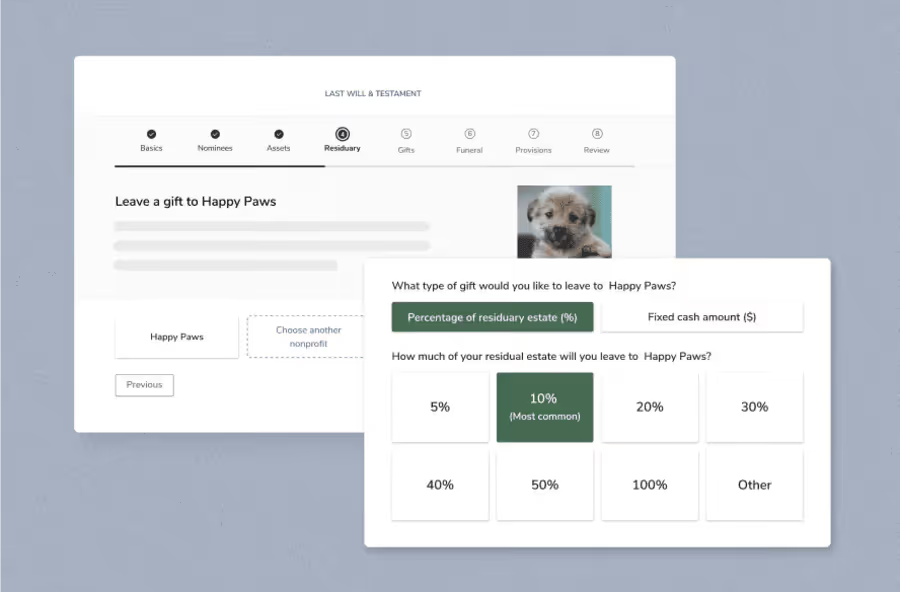
Legacy gifts (like bequests left in a will) represent some of the most transformational contributions a nonprofit will ever receive, but many organizations lack the time or tools to actively pursue them.
FreeWill’s Planned Giving Suite removes the friction for both your team and your donors, making it easier than ever to drive legacy commitments at scale. Key features include:
- Free estate planning tools: Provide your supporters with a free, intuitive way to create their legally binding wills, removing the cost and complexity of traditional estate planning while naturally prompting them to leave a legacy gift to your mission.
- Planned Giving Microsites: Educate your donors with a customized, branded hub that explains the impact and process of legacy giving, saving your team hours of answering recurring questions.
- Featureships: Reach beyond your existing donor base. This feature places your organization in front of high-affinity individuals who are already creating their wills on the FreeWill platform, helping you acquire brand-new legacy supporters.
Gifts made through estate plans on FreeWill are 4.85x larger than the national average! See how the American Heart Association generated nearly 1,400 new bequests (at an estimated value of over $65 million) through the FreeWill Nation Featureship.

Unlock tax-advantaged wealth with the Smart Giving Suite.
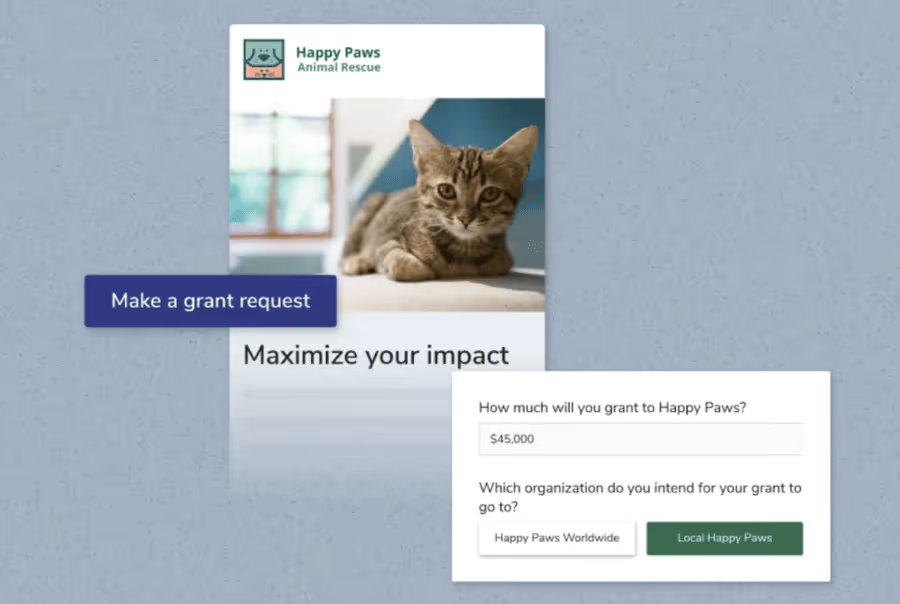
While grants inject vital capital into specific programs, non-cash giving is the secret to unlocking major, unrestricted individual wealth. A massive percentage of wealth in the U.S. is held in non-cash assets, yet many nonprofits only ask for cash because processing other gifts feels too complicated.
FreeWill’s Smart Giving Suite acts as an efficiency partner for your major gifts team. It provides intuitive, donor-facing platforms that automate the complex paperwork and routing required to accept tax-advantaged gifts.
Start accepting these types of non-cash gifts:
- Stock & securities: Enable donors to easily transfer appreciated stock, allowing them to make larger gifts while avoiding capital gains taxes.
- Donor-advised funds (DAFs): Tap into the fastest-growing vehicle in philanthropy with a frictionless tool that helps donors recommend grants directly to your organization from their DAFs.
- Qualified charitable distributions (QCDs): Provide a streamlined way for older supporters to give directly from their IRAs, meeting their required minimum distributions while supporting your cause tax-free.
- Cryptocurrency: Future-proof your fundraising by easily and safely accepting crypto donations, instantly converting them to cash for your organization.
For an example of how our Smart Giving Suite is helping real organizations, check out this video about how NOCO Humane educates their donors about non-cash giving vehicles and raises more for their mission with FreeWill.
Additional resources to fuel your grant management efforts
There are more ways than ever for organizations to unlock efficiency, but few offer as much immediate potential as AI grant writing tools. By integrating the right technology, you can transform what was once a bottleneck into a reliable revenue stream.
Don't let limited hours or small team sizes hold you back. By using AI tools like Grant Assistant to overcome your biggest hurdles (like time, capacity, and even writer’s block), you can get more proposals out the door and secure the funding your mission deserves.
As you explore your options, take a look at these additional resources about the future of nonprofit funding and development:
- 20 best AI tools for nonprofits: Unlock efficiency & funding
- Top 10+ grant writing software picks and supplemental tools
- AI grant writing tools for nonprofits: The top 15 platforms
- Grant management software: Buyer’s guide & top-rated options
- How to accept stock donations: Easy steps for nonprofits